
The PDSA cycle (Plan-Do-Study-Act) is the scientific method applied to change at work. You plan a small test and write down a prediction, run it, study the data against that prediction, then act: adopt, adapt or abandon the change. Repeated cycles, growing in scale, turn a hunch into evidence that the change is an improvement.
Dana Ruiz did everything the playbook asked. As support manager at a software company, she saw first-contact resolution stuck at 71% and wrote a new call script. She trained every agent on a Monday, published the script on the wiki, checked the dashboard after six weeks and made the script the standard.
Six weeks later the number was 72%. Her director asked one question: did the script work? Dana could not answer. One point up could be the script, a quieter month, or nothing at all. She had run a cycle, but she had not run a test.
That gap, between going through four steps and learning something, is what the PDSA cycle was designed to close.
What is the PDSA cycle?
The PDSA cycle is a four-step loop for testing a change on a small scale before spreading it. Its core is the prediction made in Plan and compared in Study: without a prediction, the data has nothing to confirm or refute. It is the learning engine of the Model for Improvement used by the Institute for Healthcare Improvement (IHI) and by Escola EDTI.
Plan, Do, Study, Act: what each step requires
Each step has a job, and each has a typical way of going wrong. The job matters more than the label.
Plan. State the objective of this cycle, the question you want answered and your prediction, with a number. Then decide who, what, where and when, and which data you will collect. “Try the new script” is not a plan. “Two agents use the new script on Tuesday’s morning shift; we predict first-contact resolution of at least 78% on their 60 calls” is.
Do. Run the test as planned and write down what happened that the plan did not foresee: the customer who hung up, the agent who skipped a step, the system that froze. Those notes are data too.
Study. Compare the result with the prediction. Where they differ, ask why. This is where knowledge is built, because a wrong prediction tells you your theory about the process was incomplete.
Act. Decide: adopt the change, adapt it and test again, or abandon it. Then plan the next cycle, usually at a larger scale or under different conditions.
Why the prediction turns an activity into a test
Think about what Dana actually knew after six weeks. She had two numbers, 71% and 72%, and no expectation written anywhere. Any result would have looked like confirmation: 72% was “a small gain”, 69% would have been “a bad month”, 75% would have been “the script working”.
A prediction removes that escape. If Dana had written “78% for two agents in one morning”, the 72% would have been a finding: the script helps less than she thought, or helps on some call types and not others. The next cycle would have tested which.
That is the scientific method in plain clothes. A hypothesis, a test that could prove it wrong, an honest comparison. It is also the reason Escola EDTI insists that change is not improvement: an improvement is a change with a positive, relevant and lasting impact, and only a comparison with a prediction, over time, can show that.
You might object that a prediction is a guess, and guessing feels unscientific. It is the opposite. The guess makes your theory visible. A theory nobody writes down can never be wrong, and a theory that can never be wrong teaches nothing.
Start small: one agent, one shift, then scale
The second rule of the PDSA cycle is scale. The first test should be small enough that failure is cheap and fast. Dana changed the work of every agent at once, so a bad script would have hurt every customer and a good one would have been buried in month-to-month variation.
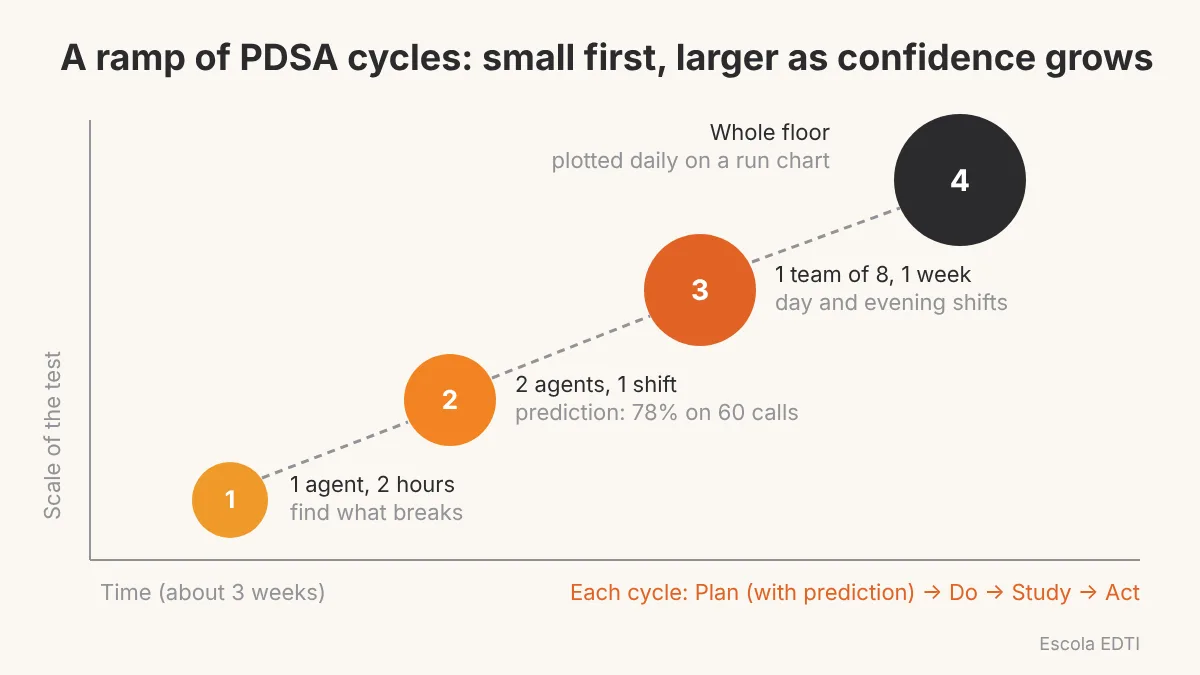
A ramp of tests looks different. Cycle 1: one agent uses the script for two hours; the goal is to find what breaks. Cycle 2: two agents for one shift, about 60 calls, with a numeric prediction. Cycle 3: one team of eight for a week, on both day and evening shifts. Cycle 4: the whole floor, with first-contact resolution plotted day by day on a run chart.
Each cycle answers a different question, and each one raises confidence before the risk grows. Four small cycles in three weeks usually teach more than one large rollout in six.
PDSA vs PDCA: is there a real difference?
The two names share a history. Walter Shewhart described a cycle of specification, production and inspection in 1939. W. Edwards Deming presented a version of it in Japan in 1950, and Japanese managers turned it into Plan-Do-Check-Act (PDCA). Deming later insisted on “Study” instead of “Check”, and the PDSA wording appears in his book The New Economics (1993). The history is documented by Ronald Moen and Clifford Norman in “Circling Back” (Quality Progress, 2010).
The difference is not cosmetic. “Check” invites a yes-or-no inspection: did we do what we planned? “Study” asks what the result teaches about the process, especially when it misses the prediction.
| Aspect | PDCA as usually practiced | PDSA |
|---|---|---|
| Starting point | An action plan | A question and a numeric prediction |
| Third step | Check whether the plan was carried out | Study the data against the prediction |
| Scale | Often full rollout | Small first, larger with each cycle |
| Data | Before and after, two points | Data over time, during the test |
| Output | A completed action | Knowledge: adopt, adapt or abandon |
Many teams that say PDCA do work this way, and many that say PDSA do not. The letters matter less than whether a prediction exists and whether the third step compares data with it.
Where the PDSA cycle fits in a method
A PDSA cycle answers one question: does this specific change work here? It does not choose the aim, the measures or the change ideas. Those come from the three questions of the Model for Improvement, which sit on top of the cycles and give them direction.
The Study step also depends on how the data is read. Comparing two numbers repeats Dana’s mistake. Plotting the measure in time order and applying the rules of a run chart, or the limits of a control chart when the series is long enough, separates a real signal from the noise every process produces.
And when nobody knows which change to test, the work comes before the cycle: understanding why the problem happens, with a disciplined root cause analysis. Testing random changes fast is still random.
When a PDSA cycle is not the next step
Three situations call for something else first. When the team has no theory about why the problem exists, study the process before testing. When the change is irreversible or unsafe to try with real customers or patients, test in simulation or on paper. When the change is already proven in this setting, the job is implementation: training, standard work and a process measure that shows people are actually doing it.
Writing the new procedure is not implementing it. A PDSA ramp is how you find out whether the procedure survives contact with a busy Tuesday.
Dana’s script may well have been good. She never found out, because she skipped the only part of the cycle that produces knowledge. A PDSA cycle is not four boxes to fill: it is a prediction you are willing to see fail.
Everything else follows from that sentence. A prediction forces a small test, because nobody wants to be publicly wrong at full scale. It forces data over time, because one point cannot confirm a number. And it forces the honest Study step, because a written prediction is impossible to reinterpret after the fact.
Content reviewed by Master Black Belt Marcelo Petenate, statistician, Unicamp graduate, master’s degree from USP and specialist in Lean Six Sigma and continuous improvement.
In this review, the focus was the role of the prediction in the Study step and the scale of the first tests.
If the prediction is what turns a cycle into a test, the skill to build first is judging data: knowing when a result is a signal and when it is the usual swing of the process. That is where the White Belt from Escola EDTI begins, with variation, data over time and the operational definition of improvement. The English version is in preparation and will be free; leave your details below to hear when it opens.
Frequently asked questions about the PDSA cycle
What does PDSA stand for?
Plan, Do, Study, Act. Plan includes the prediction; Study compares the result with it; Act decides whether to adopt, adapt or abandon the change.
Who created the PDSA cycle?
It grew from Walter Shewhart’s 1939 cycle and was developed by W. Edwards Deming, who used the PDSA wording in The New Economics (1993). Associates in Process Improvement later combined it with three questions to form the Model for Improvement.
How long should a PDSA cycle take?
The first cycles should be short: hours or days, not months. A useful rule is to ask what test you could run by next Tuesday. Larger cycles, run later, take longer because they test the change under more conditions.
What is an example of a PDSA cycle?
A clinic front desk predicts that a text reminder sent two days before visits will cut no-shows from 18% to 12% for one physician’s schedule over two weeks. The team sends the reminders, counts no-shows day by day, compares with the prediction and decides whether to extend the test to a second schedule.
Is PDSA the same as PDCA?
They share a history, but PDSA emphasizes studying the result against a prediction, while PDCA as commonly practiced checks whether the plan was carried out. The practical test is whether a written prediction exists.
Can PDSA be used with Lean Six Sigma?
Yes. Lean Six Sigma projects use PDSA cycles to test solutions before full implementation, especially in the Improve phase of DMAIC, where a pilot is a PDSA cycle under another name.
How do I start using PDSA in practice?
Pick one change you already believe in, shrink the first test to one person and one shift, and write a numeric prediction before you begin. Then plot the result over time instead of comparing two numbers. Learning to read that plot is the foundation the White Belt from Escola EDTI covers.